
A basic TDS pen costs about Rs 1,500 to Rs 1,800 in Pakistan. A branded pocket tester, like Hanna's DiST range, costs Rs 9,500 to Rs 21,000. For checking a home filter or the output of an RO plant, the basic pen does the job, as long as you calibrate it and always compare readings on the same meter. No TDS meter, cheap or expensive, can tell you whether water is safe.
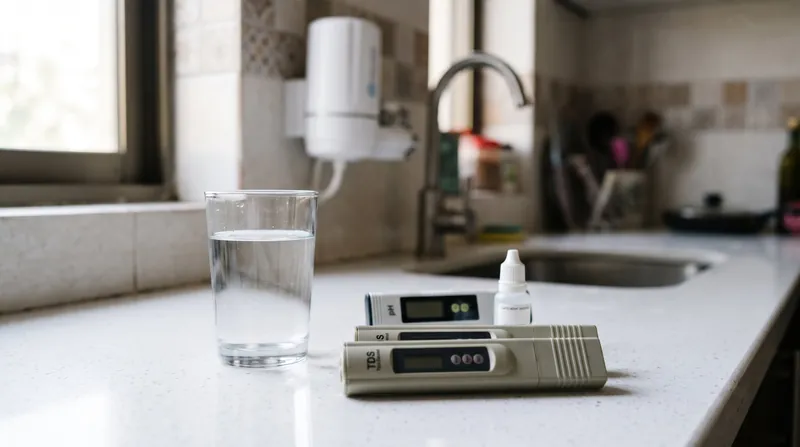
TDS pens have become a common sight in Pakistan. In September 2026, APP reported that they were catching on in Islamabad as people started checking their own water. Most people buy one, dip it, see a number and then wonder what it means. This guide covers what to pay, what the extra money gets you, and how to take a reading you can trust.
TDS meter prices in Pakistan start around Rs 1,500
We checked Pakistani online shops on 30 October 2026. Prices are rounded and sale prices change often, so treat this as a guide.
| Type of meter | What you get | Price seen |
|---|---|---|
| Basic TDS pen (3-in-1: TDS, EC, temperature) | Fine for homes, shops and quick checks at a plant | Rs 1,500–1,800 |
| Multi-parameter tester (pH, TDS, EC, salinity) | One device for pH and TDS | About Rs 8,500 |
| Branded pocket tester (e.g. Hanna DiST 1 and DiST 2) | Known brand, better build, documented accuracy | Rs 9,500–21,000 |
| Professional pH/EC/TDS meter (e.g. Hanna HI98129) | Lab and plant use, several readings in one | About Rs 58,000 |
Sources: Aqua Zoom, TDS meters (prices checked 30 Oct 2026); Aqua Water Filters Pakistan, TDS water meter (page updated July 2026); Test Instruments Pakistan, TDS meters (prices checked 30 Oct 2026).
A pH meter costs a bit more and needs more care
If you run a plant, you'll want pH as well as TDS, especially if you add sodium bicarbonate to correct it. One Pakistani price list shows pocket pH meters from about Rs 3,700 (Ezdo PH5011) to Rs 10,400 (Hanna HI98108), though it says those are 2023 prices. In October 2026, Aqua Zoom listed its 7-in-1 tester, which also reads pH, at Rs 8,499, and the Hanna DiST pH pen at Rs 16,200.
A pH meter is calibrated with buffer solutions, and most need their probe kept moist in storage. Check the manual before you buy, so you know which buffers and storage solution to order with it.
Sources: W11 Stop, TDS and pH meter price list; Aqua Zoom, TDS meters (prices checked 30 Oct 2026).
The extra money buys consistency, not a different measurement
Every meter in the table works the same way. What you pay more for is how steady and repeatable the number is:
- Temperature compensation (ATC). Conductivity changes with temperature, so a meter without it reads differently in a cold morning sample and a warm afternoon one.
- Stated accuracy. One basic pen sold in Pakistan lists ±2%. Branded testers publish their accuracy and how it was checked.
- Calibration. Better meters let you calibrate more precisely and hold it longer.
- Build. Waterproof cases and replaceable batteries matter if the meter lives next to a filling line.
For most homes, a basic pen is enough. For a plant, the bigger win is calibrating regularly and using one meter for every comparison. Brand comes second.
A TDS meter measures electricity, then converts it
A TDS pen doesn't weigh anything. It passes a small current between two metal probes and measures how easily that current flows. Dissolved salts carry electricity, so more salts means higher conductivity.
The meter then multiplies conductivity by a conversion factor to estimate TDS. Australia's drinking water guidelines say these factors range from 0.50 to 0.64. That's why two meters can show different numbers for the same glass of water, and why you shouldn't compare readings across meters.
TDS (mg/L) ≈ conductivity (µS/cm) × conversion factor
Source: NHMRC, Australian Drinking Water Guidelines: Total dissolved solids.
How to use a TDS meter: six steps
- Take the cap off and switch it on. Check the battery if the screen is faint.
- Rinse the probe with a little of the water you're about to test, then shake it dry.
- Use a clean glass. Fill it with enough water to cover the probe up to the line marked on the pen.
- Dip and stir gently to knock off air bubbles. Don't let the probe touch the glass.
- Wait for the number to settle, usually a few seconds, then read it or press hold.
- Rinse, dry and cap it. Write the reading down with the date, time and water temperature.
Check calibration with the solution your meter's manual names. A plant that relies on daily readings should make that a monthly habit.
Two readings tell you how your RO membrane is doing
At a plant, one reading on its own says little. Take one reading of the feed water going into the RO and one of the product water coming out of the membrane, then work out rejection:
Rejection (%) = (Feed TDS − Product TDS) ÷ Feed TDS × 100
Say your feed reads 800 and your product water reads 24. That's (800 − 24) ÷ 800 × 100 = 97% rejection. Log it every week. If the feed stays steady but rejection keeps sliding, the membrane needs attention. Our RO membrane and filters guide lists what to check next.
Don't expect your pen to match a membrane's data sheet. DuPont rates its BW30-4040 at 99.5% salt rejection, but under fixed lab conditions (2,000 ppm salt water at 25 °C). Your reading depends on your water, pressure, temperature and your meter's conversion factor.
Source: DuPont, FilmTec BW30-4040 product data sheet.
A TDS meter can't tell you if water is safe
This is the limit everyone needs to know. A PCRWR laboratory director told APP that TDS pens can't detect arsenic, nitrate, fluoride, heavy metals or germs, and that water with an "ideal" TDS can still be unsafe. A TDS pen is a screening tool. For safety you need a lab test.
If you run a bottled water unit in Punjab, you already need one: the Punjab Food Authority requires a monthly test at a PFA-approved laboratory. Use your TDS pen to spot changes between those tests.
Want to know what your number means? Our TDS chart for drinking water lists each range with Pakistan's limits, and the TDS guide explains what TDS is made of.
Sources: APP (2 Sept 2026), TDS testing pens gain popularity in Islamabad amid water-quality concerns; APP (18 Nov 2025), PFA issues new SOPs for commercial water filtration plants.
Raising TDS after RO?
Food-grade calcium chloride, magnesium sulphate and sodium bicarbonate at Rs 800 per kg. Each gram raises TDS by a known amount, so your meter shows exactly what you added.
Frequently asked questions
How much is a TDS meter in Pakistan?
About Rs 1,500 to Rs 1,800 for a basic TDS pen, and Rs 9,500 to Rs 21,000 for a Hanna pocket tester, based on Pakistani online listings checked on 30 October 2026.
Which TDS meter is best for home use?
A basic pen with temperature compensation (ATC) is enough for checking water before and after a filter. Calibrate it and use the same pen every time you compare.
Are cheap TDS meters accurate?
Accurate enough for comparisons, if you calibrate them. One basic pen sold in Pakistan lists ±2% accuracy. Meters use different conversion factors, so don't compare readings from two different meters.
How often should I calibrate a TDS meter?
Follow the manual. If you rely on daily readings at a plant, check it against calibration solution at least once a month.
Can a TDS meter detect arsenic or bacteria?
No. It only gives the total of everything dissolved. A PCRWR laboratory director has said TDS pens can't detect arsenic, nitrate, fluoride, heavy metals or germs. You need a lab test for that.
What is the price of a pH meter in Pakistan?
Pocket pH meters start around Rs 3,700 on one Pakistani price list (2023 prices), and a 7-in-1 tester that reads pH and TDS was Rs 8,499 in October 2026. Hanna's DiST pH pen was listed at Rs 16,200.
Sources
- Aqua Zoom, TDS meters (prices checked 30 Oct 2026)
- Aqua Water Filters Pakistan, TDS water meter (page updated July 2026)
- Test Instruments Pakistan, TDS meters (prices checked 30 Oct 2026)
- W11 Stop, TDS and pH meter price list
- NHMRC, Australian Drinking Water Guidelines: Total dissolved solids
- DuPont, FilmTec BW30-4040 product data sheet
- APP (2 Sept 2026), TDS testing pens gain popularity in Islamabad amid water-quality concerns
- APP (18 Nov 2025), PFA issues new SOPs for commercial water filtration plants
Related: TDS of drinking water: chart for Pakistan · What is TDS in water? · RO membrane and filters guide · Our minerals and prices